A lot of people think that a healthy heart is dependent solely on exercise and diet. Breathing is rarely a part of the conversation. Yet breathing affects how fast your heart beats, how hard it works, and how well it recovers. This article focuses on better breathing for a strong heart because breathing has a direct impact on how your heart behaves and how it can be trained using simple habits.
Each breath you take not only changes the pressure in the chest but your blood flow, and heart rate. Poor breathing keeps the heart working harder than necessary. Better breathing improves heart rate and recovery.

Breathing Sets the Pace of the Heart
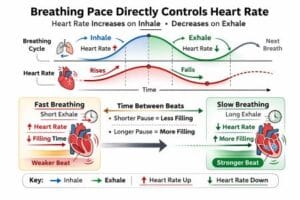
Breathing directly controls each beat of your heart.
- Inhale → heart rate increases
- Exhale → heart rate decreases
This is how the heart and lungs work together. Each breath sends a physical signal that changes the timing of the next heart beat. No thoughts or feelings needed.
When breathing remains fast or uneven:
- Heart rate is elevated
- Time between beats shortens
- The heart fills less before each contraction
When breathing slows down and becomes steady:
- Heart rate drops
- Time between beats increases
- Each beat becomes more controlled
This is why better breathing for a strong heart begins with controlling the pace of breathing. You aren’t forcing the heart to slow down. You are changing the actual signal that sets the heart rate. That signal comes directly from each breath you take.
Slower Breathing Allows Stronger Heart Beats
How strongly your heart pumps depends on how much time it has to fill with blood between each beat. Breathing pace controls that time [1].
When breathing is fast:
- Heart rate stays high
- Time between beats shortens
- The heart fills less before each beat
- Each contraction pushes out less blood
When breathing slows:
- Heart rate drops
- Time between beats increases
- The heart fills more completely
- Each beat becomes stronger and more efficient
The reason this matters is because the heart works best when it does more work per beat, not more beats per minute. Slower breathing allows for this by giving the heart enough time to load before it contracts.
You are not trying to relax your heart. You are allowing it to pump with greater force by controlling the time between beats. That is the main reason breathing for a strong heart focuses on slowing the breath first.
Breathing Changes How Hard the Heart Has to Work
Breathing does more than control the heart rate. It also impacts how much effort each heart beat requires [2].
Every breath changes the pressure inside your chest. That pressure affects how easily blood returns to the heart and how much force the heart must use to push blood.
When breathing is shallow or quick:
- Pressure inside the chest stays higher
- Less blood returns to the heart between beats
- The heart must contract with more force to maintain blood flow
When breathing is slow and controlled:
- Chest pressure drops during each breath
- More blood returns to the heart before each beat
- The heart moves blood with less force per contraction
This directly lowers cardiac workload. The heart does not need to push as hard to circulate the same amount of blood. Over time, this supports a stronger and more efficient heart.
This is another reason breathing for a strong heart matters. You are not pushing the heart harder. You are reducing the resistance it works against.
Nasal Breathing Improves Heart Rhythm Control
Nasal breathing changes how evenly the heart speeds up and slows down from one beat to the next. This affects rhythm control directly.
When breathing happens through the nose:
- Breathing rate stays more consistent
- Changes in heart rate happen gradually
- Time between heart beats varies in a controlled way
Nasal breathing also increases nitric oxide released in the nose. This increases blood vessel dilation, which helps keep steady blood flow and decrease sudden changes in heart rhythm. This effect is physical, not emotional.
When breathing through the mouth:
- Breathing rate becomes erratic
- Heart rate changes occur in larger amounts
- Timing between beats becomes less consistent
A heart that adjusts speed gradually works with less strain than one that changes abruptly. Over time, smoother beat-to-beat control allows for a more efficient heart.
This is another reason breathing for a strong heart should focus on nasal breathing whenever possible.
Breathing Trains the Heart’s Control System
The heart is controlled by automatic signals that speed it up or slow it down.
When breathing stays fast or irregular:
- Signals that speed the heart become stronger
- Heart rate stays higher longer than needed
- Recovery after effort takes more time
When breathing is slow and steady:
- Signals that slow the heart become stronger
- Heart rate drops more quickly after activity
- The heart returns to its normal resting rate sooner
This does not have a short-term effect. When you repeat slow, controlled breathing it trains the system that manages the speed and recovery of the heart. Over time, the heart becomes better at changing pace when needed and switching to a resting rate when activity drops.
A heart that can speed up and slow down efficiently is better able to handle daily demands with less wear. That is the result of training and not a mystic trick, and is the basis of breathing for a strong heart.

Simple Breathing Habits That Support a Strong Heart
Strengthening the heart through breathing isn’t difficult or complex. It needs the formation of consistent, repeatable habits that change how the heart behaves normally throughout the day.
Slow nasal breathing at rest
- Breathe through the nose
- Keep breathing quiet and controlled
- Slow down your breathing to fewer breaths per minute
This lowers your resting heart rate and increases the time between heart beats without needing extra effort.
Longer exhales
- Let the exhale last slightly longer than the inhale
- Do not force air out
A longer exhalation gives the heart more time between beats and supports quicker recovery after exertion.
Light breathing during daily activity
- Avoid breathing hard unless your level of effort requires it
- Breathe lightly during easy movement and only breathe harder as effort increases.
This prevents your heart rate from unnecessarily rising during low effort activity.
Consistency over intensity
- Practice daily not randomly
- Short sessions done frequently matter more than long sessions done rarely
These habits are effective because they are done regularly rather than occasionally by directly impacting how the heart behaves. Over time, the heart adapts to this regular change and works with less strain.
This is the practical side of breathing for a strong heart—simple actions that change how the heart performs throughout the day.
How Breathing Supports Other Heart-Strengthening Habits
Better breathing doesn’t replace exercise or sound sleep. It makes both of these work better by changing how the heart responds before, during, and after it is used.
Exercise recovery
- Controlled breathing brings heart rate down faster after activity
- Faster recovery allows higher training quality and frequency
- The heart spends less time struggling to regain normalcy
Sleep-related heart recovery
- Slower, nasal breathing during sleep keeps nighttime heart rate lower
- Longer low heart rate periods give the heart more time to recover
- This allows for more time for rest and repair between training days
Training tolerance
- More efficient breathing delays early fatigue
- Better breathing increases tolerance to increased CO₂ and a faster heart rate, which allows longer and more consistent training sessions.
- Consistency effort strengthens the heart more than occasional effort
Better breathing strengthens these habits by shortening recovery time and reducing unnecessary load on the heart (cardiac load). That allows the heart to benefit more from exercise and sleep without added strain.
Conclusion: A Strong Heart Responds to Better Breathing
Breathing impacts how fast your heart beats, how hard it works, and how quickly it recovers. This happens with each breath, whether you notice or not.
By improving your pace, deepness, and control of breathing, you reduce unnecessary strain and allow each heart beat to do more work with less effort. This is why breathing for a strong heart is a practical skill that impacts your heart performance and health. Better breathing does not ask the heart to work harder. It allows it to work better.
Check out Breathing as a Daily Practice to Best Support Change.